
Quick Answer
frequency rate meaning means how often something happens within a specific period, population, or amount of exposure. It is commonly used in statistics, workplace safety, business, and research to measure the number of events or incidents relative to a defined base, such as hours worked or people observed.
Meaning
The phrase frequency rate describes the rate at which something occurs or is repeated.
The word frequency refers to how often an event happens, while rate indicates that the occurrence is measured against a particular unit, period, population, or amount of activity.
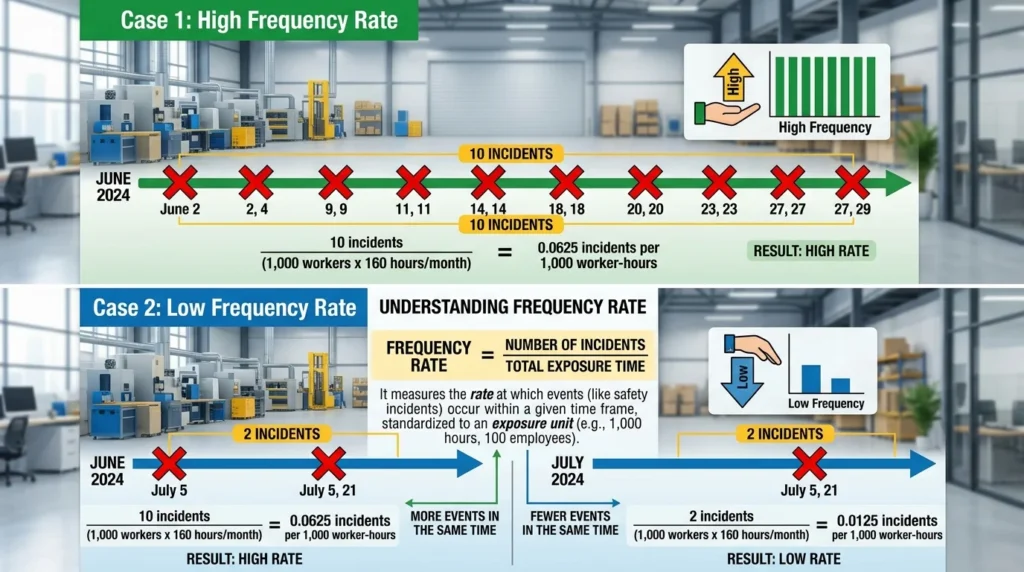
For example, if a workplace has 5 safety incidents during 100,000 hours worked, the organization can calculate an incident frequency rate. The resulting figure provides more useful information than simply saying that five incidents occurred because it considers the amount of work or exposure involved.
The exact meaning of frequency rate can vary by field. In everyday language, it may simply mean how often something occurs. In technical fields, it often refers to a calculated measurement using a specific formula.
Definition in Simple Words
In simple English, frequency rate means how often something happens compared with a particular amount of time, people, work, activity, or exposure.
For example:
- If 10 accidents happen in a year, their frequency can be measured.
- If 10 accidents happen among 1,000 workers, a frequency rate can compare those incidents with the workforce.
- If a machine fails 4 times during 2,000 operating hours, its failure frequency can be measured against operating time.
So, the basic idea is:
Frequency rate = how often something happens in relation to a defined base.
Pronunciation
Frequency rate
- Pronunciation: /ˈfriː.kwən.si reɪt/
- Frequency: noun
- Rate: noun
- Part of speech: noun phrase
The word frequency is pronounced approximately “FREE-kwuhn-see,” while rate is pronounced “rayt.”
Origin and Etymology
Frequency comes from the Latin frequentia, meaning abundance, crowd, or repeated occurrence. It developed through Old French and Middle English before taking its modern English form.
Rate ultimately traces back through Old French to Latin rata, related to something reckoned, calculated, or fixed.
Together, frequency rate developed as a natural technical expression for describing how frequently something occurs relative to a specified measure.
The exact formula associated with the phrase depends on the field in which it is being used. There is therefore no single universal frequency-rate calculation applicable to every situation.
Meaning in Different Contexts
Frequency Rate in Everyday English
In ordinary conversation, frequency rate can mean the regularity or occurrence of an event.
For example:
- “The frequency rate of train delays has increased.”
- “We need to monitor the frequency rate of customer complaints.”
In casual English, people may simply say frequency, how often, or rate of occurrence instead.
Frequency Rate in Statistics
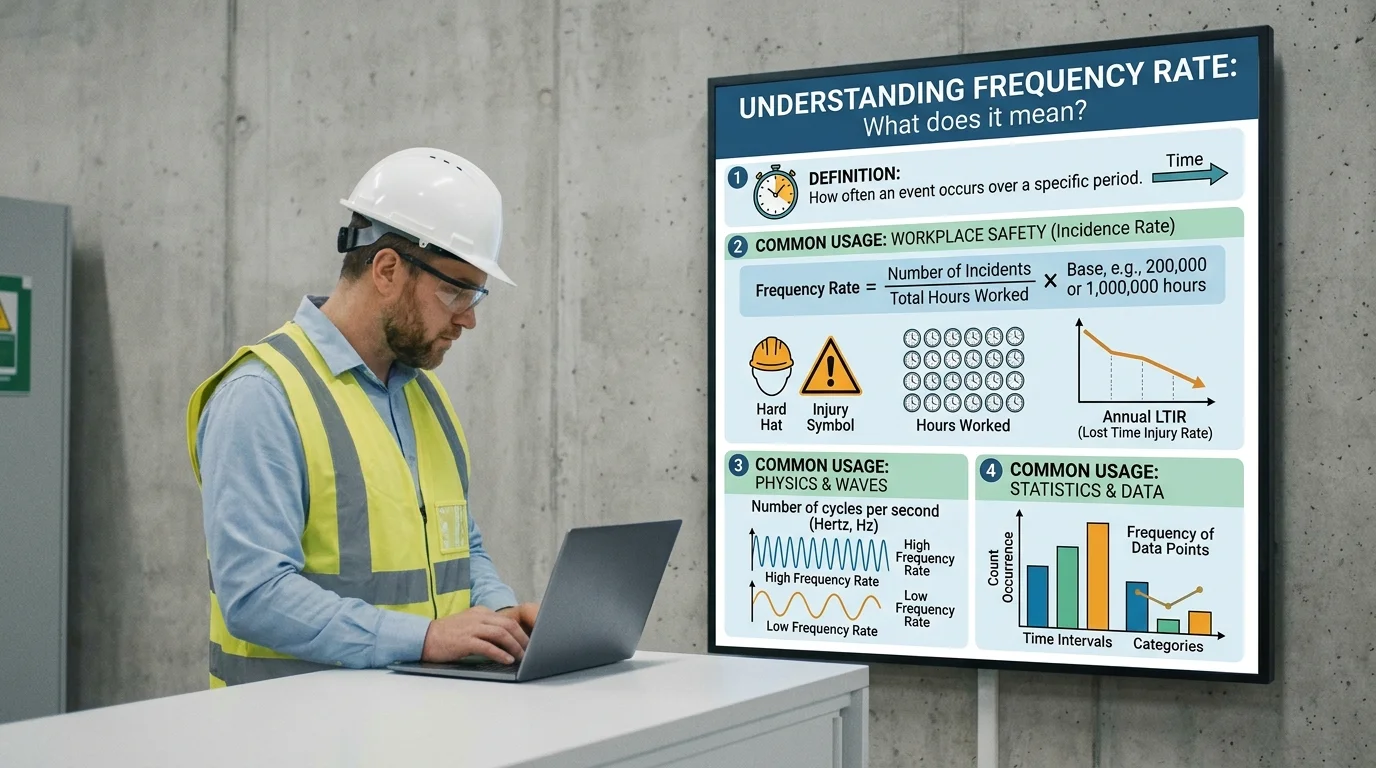
In statistics, a frequency rate measures how often an event occurs relative to a specified population, period, or exposure.
This makes it possible to compare groups of different sizes.
For example, 20 incidents in a group of 10,000 people cannot be fairly compared with 20 incidents in a group of 500 people without considering the size of each population.
Frequency Rate in Workplace Safety
Workplace safety is one of the most common technical contexts for the term.
Organizations may calculate an incident or injury frequency rate using the number of incidents relative to hours worked or another standardized exposure measure.
A commonly used structure is:
Frequency rate = (Number of incidents ÷ total exposure) × standardizing factor
The standardizing factor varies according to the reporting system or organization. Therefore, a frequency rate should always be interpreted together with its stated formula and denominator.
Frequency Rate in Business
Businesses may use frequency rates to track recurring events such as:
- Customer complaints
- Equipment failures
- Product defects
- Employee incidents
- Service interruptions
- Sales transactions
- Website events
A business might compare the frequency rate of customer complaints before and after changing a product.
Frequency Rate in Education
In education and research, frequency rates can describe how often particular behaviors, responses, errors, or events occur.
For example, a researcher might calculate how frequently students make a particular type of grammatical error.
Frequency Rate in Medicine and Public Health
In medical and public-health contexts, frequency-related measures can describe the occurrence of diseases, symptoms, injuries, or other health events.
However, terms such as incidence rate, prevalence, and mortality rate have specific technical meanings and should not automatically be treated as interchangeable with frequency rate.
Frequency Rate in Psychology
Psychologists and behavioral researchers may use frequency measurements to record how often a behavior occurs.
For example, a study could measure the number of times a participant performs a particular behavior during an observation period.
Frequency Rate in Social Media
In digital marketing and social media analytics, frequency can describe how often users are exposed to an advertisement or how frequently a particular action occurs.
For example, advertising platforms may use ad frequency to describe the average number of times a person sees an advertisement.
Frequency Rate in Engineering
Engineers may measure how frequently equipment failures, defects, system interruptions, or other events occur during a defined operating period.
This can help identify reliability problems and compare equipment performance.
Frequency Rate in Law and Regulation
In legal, regulatory, or compliance contexts, a frequency rate may be used in reports to quantify how often certain incidents or violations occur.
Its interpretation depends heavily on the regulatory definition and reporting methodology.
Examples
Here are practical examples of frequency rate in different situations:
- A factory records its workplace injury frequency rate each year.
- A hospital tracks the frequency rate of certain infections.
- A company measures the frequency rate of customer complaints.
- An airline monitors the frequency rate of flight delays.
- A manufacturer calculates the frequency rate of machine failures.
- A school studies the frequency rate of absenteeism.
- A website measures the frequency rate of certain user actions.
- A researcher records the frequency rate of a particular behavior.
- A warehouse tracks the frequency rate of workplace accidents.
- A telecommunications company measures the frequency rate of service interruptions.
- A business compares complaint frequency rates between two branches.
- A factory compares equipment failure rates across different machines.
- A marketing team examines advertising frequency.
- A transportation company tracks breakdown frequency.
- A laboratory records how frequently particular test results occur.
- A quality-control team monitors the frequency of defective products.
- A manager examines the frequency of employee errors.
- A researcher compares event frequency between two populations.
Example Sentences
- The company calculated its workplace injury frequency rate for the previous year.
- The frequency rate of equipment failures decreased after maintenance procedures were improved.
- Managers monitor the frequency rate of customer complaints every month.
- The report shows a higher frequency rate among older machines.
- Researchers examined the frequency rate of the behavior during the study.
- The hospital tracks the frequency of infections across different departments.
- The factory’s accident frequency rate improved significantly.
- We need more data before comparing the frequency rates of the two groups.
- The frequency rate is calculated using the number of incidents and the relevant exposure measure.
- A high frequency rate may indicate that an event is occurring more often.
- The company reviews its frequency rate as part of its safety program.
- The researchers recorded the frequency rate of errors made by participants.
- The frequency rate of service interruptions fell after the network was upgraded.
- The manager noticed an increase in the frequency rate of customer returns.
- The study measured how the frequency rate changed over time.
- Different industries may use different definitions and formulas for frequency rates.
- The frequency rate provides a more useful comparison than a simple incident count in some situations.
- The report included both the total number of incidents and the frequency rate.
- Analysts compared the frequency rate before and after the new policy was introduced.
- Always check the denominator and calculation method before interpreting a frequency rate.
Synonyms
The best synonym depends on the context because frequency rate is often a technical measurement.
- Rate of occurrence — emphasizes how often an event happens.
- Occurrence rate — focuses on the number of events occurring within a defined base.
- Frequency — describes how often something happens but may not include a standardized denominator.
- Incidence rate — a specific epidemiological term and not a universal synonym.
- Event rate — commonly used when measuring occurrences of defined events.
- Occurrence frequency — emphasizes repetition or regularity.
- Recurrence rate — specifically focuses on events happening again.
- Failure rate — used particularly for equipment, systems, or products that fail.
- Incident rate — often used for workplace or safety events, although definitions vary.
- Repetition rate — emphasizes how frequently an action or event is repeated.
Antonyms
There is no single perfect antonym for frequency rate, but these terms express opposing ideas depending on context:
- Infrequency — something happens rarely.
- Rarity — an event occurs very seldom.
- Low occurrence — indicates that something happens relatively rarely.
- Sporadic occurrence — describes events that happen irregularly.
- Non-occurrence — means that an event does not happen.
- Zero occurrence — indicates that no events were recorded during the measured period.
Similar or Commonly Confused Words
Frequency vs. Frequency Rate
Frequency tells you how often something occurs.
Frequency rate generally expresses that frequency relative to a defined base.
For example, “20 accidents” is a count. A frequency rate might express those accidents relative to hours worked.
Frequency Rate vs. Incidence Rate
These terms can overlap in some contexts, but incidence rate has a more specific technical meaning in epidemiology.
Incidence generally concerns new cases or events occurring within a population over a specified period, often accounting for person-time at risk.
Therefore, it is better not to use the two terms interchangeably without checking the context.
Frequency Rate vs. Occurrence Rate
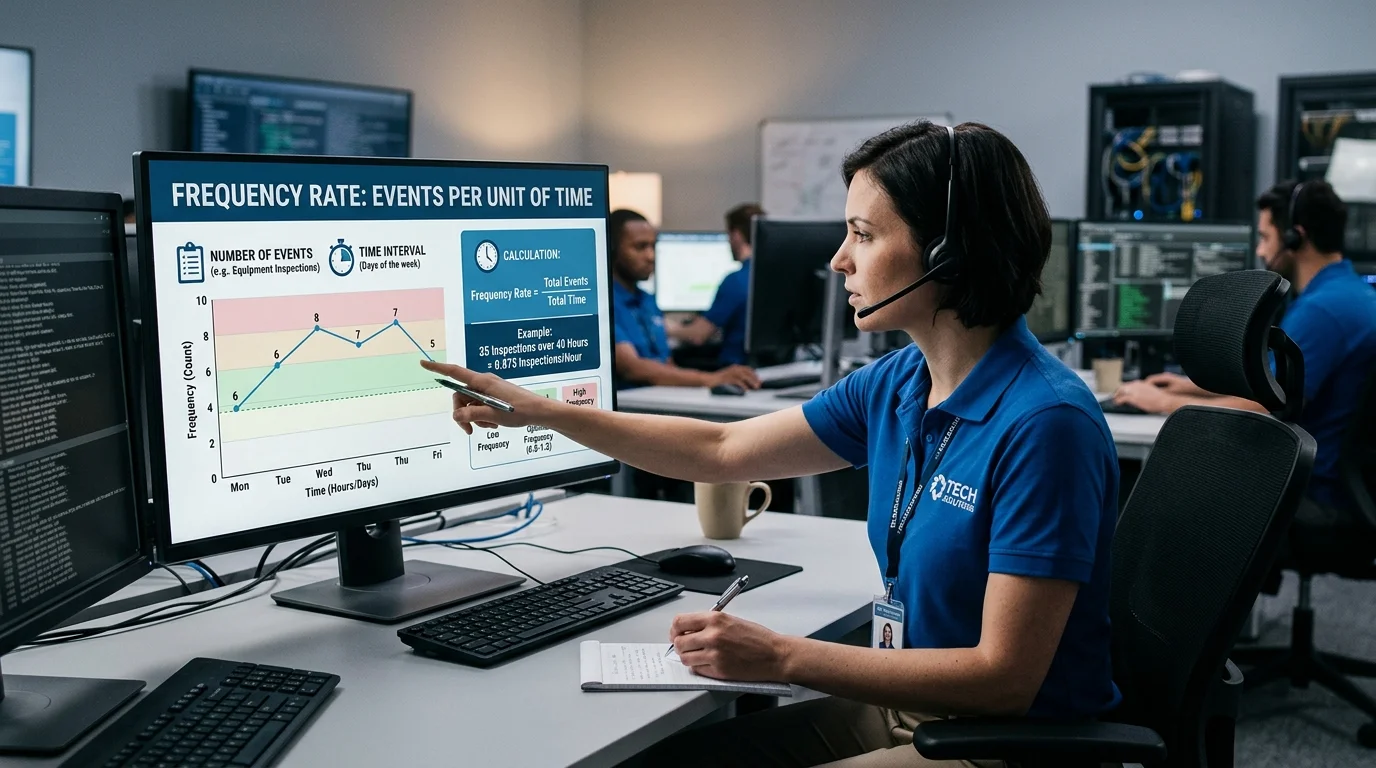
These are often close in meaning. Both can describe how often something happens relative to a particular measurement.
However, frequency rate is more common in certain technical and reporting contexts.
Frequency Rate vs. Percentage
A percentage expresses a proportion out of 100.
A frequency rate may use a completely different denominator, such as hours worked, machine operating hours, population size, or another exposure measure.
Frequency Rate vs. Ratio
A ratio compares two quantities. A frequency rate may also involve a ratio, but it specifically measures occurrence relative to a defined base and often includes a time or exposure component.
Common Mistakes
Treating Frequency and Frequency Rate as Identical
Although closely related, they are not always identical.
Frequency can simply mean the number of times something occurs. A frequency rate generally places that occurrence in relation to another measurement.
Assuming There Is One Universal Formula
There is no single formula that applies to every use of frequency rate.
A workplace, research study, business, and engineering report may use different denominators and standardizing factors.
Ignoring the Denominator
The denominator is extremely important.
A statement such as “the company had 50 incidents” gives limited information. Knowing the number of workers, hours worked, units produced, or another relevant exposure measure may provide a more meaningful comparison.
Confusing Frequency With Probability
Frequency describes observed occurrences, while probability describes the likelihood of an event.
They are related concepts in statistics but are not identical.
Using Technical Terms Interchangeably
Terms such as frequency rate, incidence rate, prevalence, failure rate, and percentage can have specialized meanings.
The correct term depends on the field and calculation method.
Comparing Rates Without Checking Their Formulas
Two organizations may both report a “frequency rate” while using different calculation methods.
Before comparing figures, check the numerator, denominator, time period, and standardizing factor.
When and How to Use This Word
Frequency rate is most appropriate when discussing a measurable pattern of repeated events.
It is commonly used in:
- Workplace safety
- Statistics
- Research
- Business analytics
- Engineering
- Quality control
- Public health
- Operations
- Reliability analysis
- Marketing and advertising
The phrase is generally neutral and professional rather than slang or informal.
In everyday conversation, however, native speakers often choose simpler expressions such as:
- “How often does it happen?”
- “How frequently does this occur?”
- “The rate of occurrence”
- “How common is it?”
- “How often this happens”
In technical writing, frequency rate is useful when the calculation and measurement method are clearly defined.
Related Expressions
Several expressions are closely associated with frequency rate:
- Rate of occurrence — how often an event occurs relative to a specified base.
- Frequency of occurrence — the number or regularity of times an event occurs.
- Incident frequency rate — a rate used to describe the occurrence of incidents.
- Injury frequency rate — commonly associated with workplace safety reporting.
- Failure frequency — how often equipment or systems fail.
- Recurrence rate — how often something happens again.
- Event rate — the rate at which specified events occur.
- Incidence rate — a specialized epidemiological measure.
- Ad frequency — how often an individual is exposed to an advertisement.
- Frequency distribution — a statistical arrangement showing how often values or categories occur.