
Definition in Simple Words
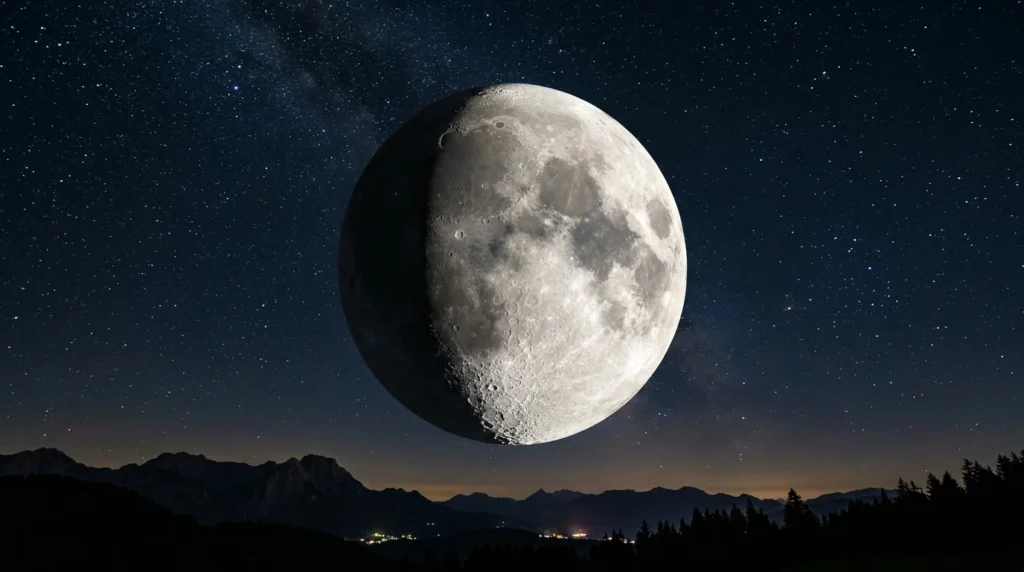
In simple English, a gibbous Moon is a Moon that looks more than half full but not completely full.
Think of the lunar cycle as a gradual change:
Half Moon → Gibbous → Full Moon → Gibbous → Half Moon
A waxing gibbous Moon is getting brighter and fuller.
A waning gibbous Moon is getting less illuminated and appears to shrink toward a half moon.
Pronunciation
Gibbous
- Pronunciation: /ˈɡɪbəs/
- Approximate pronunciation: “GIB-us”
- Part of speech: adjective
Gibbous phase
- Pronunciation: “GIB-us fayz”
- Part of speech: noun phrase
The word gibbous is also used more generally to describe something that is rounded or bulging outward.
Origin and Etymology
The word gibbous comes from Latin gibbus, meaning “hump” or “humped.”
It entered English through French and developed its astronomical meaning because a gibbous Moon appears to have a rounded, bulging shape.
The term has been used in descriptions of the Moon for centuries.
In astronomy, gibbous specifically refers to a phase in which the visible illuminated portion is greater than half but less than the entire lunar disk.
Meaning in Different Contexts
Gibbous Phase in Astronomy
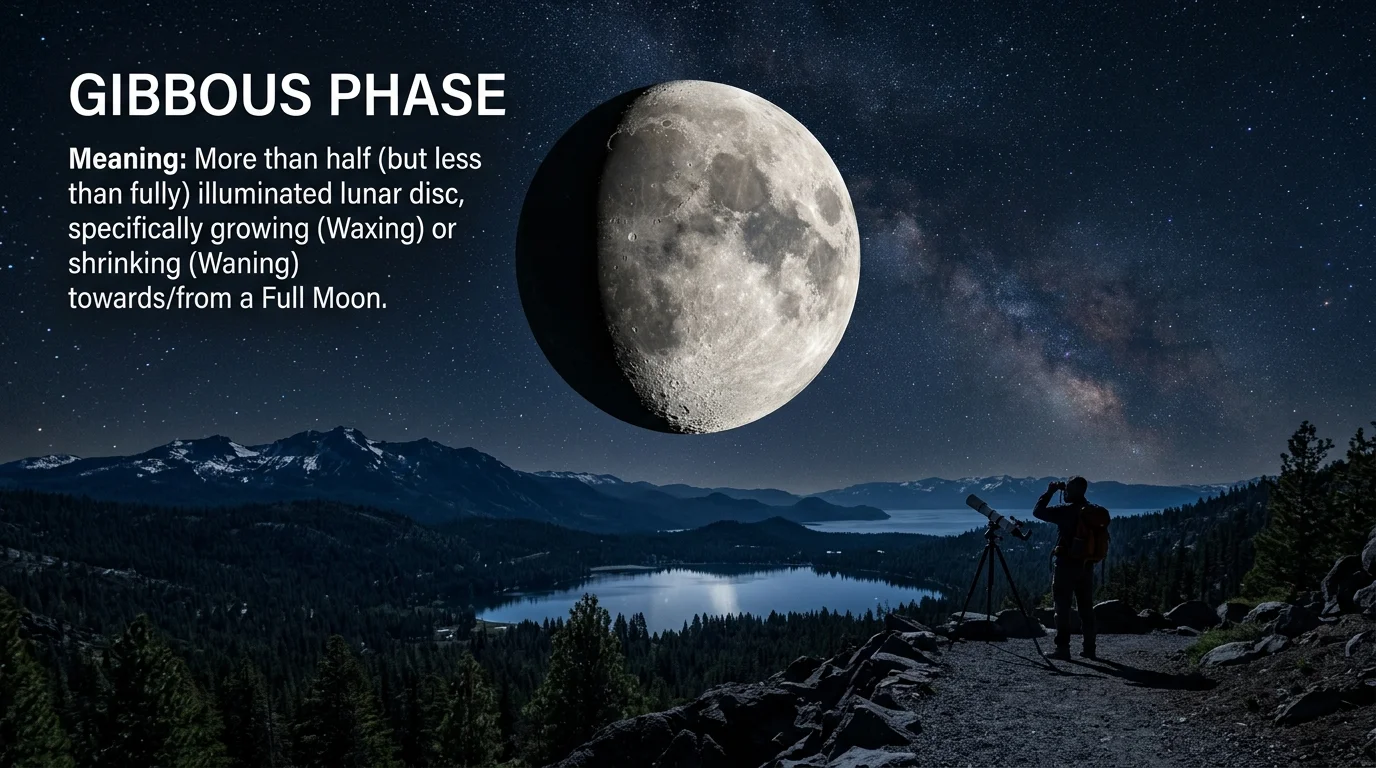
In astronomy, the gibbous phase occurs when an observer on Earth sees more than 50% but less than 100% of the Moon’s visible disk illuminated.
The Moon’s phases result from the changing geometry between:
- The Sun
- Earth
- The Moon
As the Moon orbits Earth, we see different proportions of its sunlit side.
Waxing Gibbous Meaning
A waxing gibbous Moon occurs after the first quarter phase and before the full moon.
During this period:
- More than half of the Moon appears illuminated.
- The illuminated area continues to increase.
- The Moon is approaching full moon.
- It generally appears larger and brighter each night.
“Waxing” means increasing or growing.
Waning Gibbous Meaning
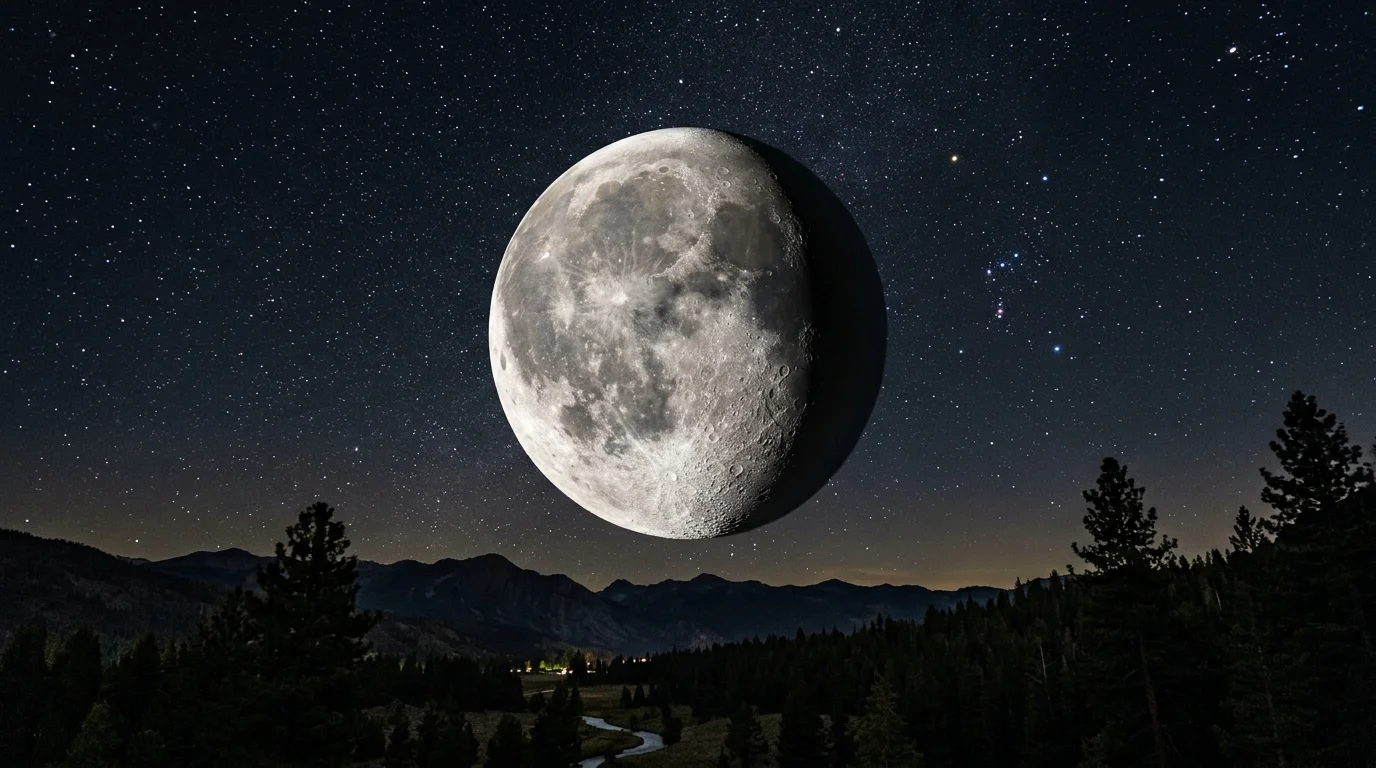
A waning gibbous Moon occurs after the full moon and before the third quarter.
During this period:
- More than half of the Moon remains illuminated.
- The illuminated portion gradually decreases.
- The Moon is moving toward the third-quarter phase.
- It generally appears less illuminated each night.
“Waning” means decreasing or becoming less.
Gibbous Phase in the Lunar Cycle
The Moon’s commonly recognized phases are:
- New moon
- Waxing crescent
- First quarter
- Waxing gibbous
- Full moon
- Waning gibbous
- Third quarter
- Waning crescent
The two gibbous phases occupy an important part of the lunar cycle.
Gibbous Phase and the Full Moon
A gibbous Moon is not the same as a full moon.
During a full moon, the visible lunar disk appears essentially completely illuminated from Earth’s perspective.
During a gibbous phase, only more than half of the visible disk is illuminated.
Therefore:
Gibbous = more than half illuminated
Full = essentially all of the visible disk illuminated
Gibbous Phase and the Quarter Moon
A quarter moon has approximately half of the visible lunar disk illuminated.
A gibbous moon has more than half illuminated.
This makes the gibbous phases the transition between a quarter moon and a full moon.
Gibbous Phase and Moonlight
A gibbous Moon can appear very bright because a large portion of its visible surface is illuminated by sunlight.
The Moon’s brightness can be especially noticeable when it is high in the night sky.
However, the exact appearance and brightness depend on factors such as:
- Atmospheric conditions
- Moon altitude
- Local light pollution
- Observation time
- The Moon’s position
Gibbous Phase and Moonrise
The time of moonrise depends on the Moon’s phase.
A waxing gibbous Moon generally rises in the afternoon or around early evening and is prominent during the evening and night.
A waning gibbous Moon generally rises later in the evening and can remain visible into the morning.
These are approximate patterns rather than exact daily times.
Gibbous Phase in Culture
The Moon has been important in calendars, traditions, literature, agriculture, art, and storytelling across many cultures.
The gibbous phases can be particularly recognizable because the Moon appears almost full while still having a visible curved edge.
However, the astronomical meaning of gibbous remains the same regardless of cultural interpretation.
Examples
- The Moon was in a waxing gibbous phase before the full moon.
- We watched the gibbous Moon rise over the horizon.
- The waning gibbous phase followed the full moon.
- More than half of the Moon was illuminated.
- The photographer captured a bright gibbous Moon.
- The waxing gibbous Moon became brighter each evening.
- The waning gibbous Moon appeared later at night.
- The Moon looked almost full during the gibbous phase.
- Students learned about the gibbous phase in astronomy class.
- The lunar calendar showed a waxing gibbous Moon.
- The gibbous Moon was clearly visible through the clouds.
- The Moon changed from first quarter to waxing gibbous.
- The full moon was preceded by a waxing gibbous phase.
- A waning gibbous Moon appears after the full moon.
- The observer recorded the Moon’s phase in a notebook.
- The gibbous Moon illuminated the landscape.
- The astronomer explained the difference between waxing and waning gibbous phases.
- The Moon appeared more than half illuminated.
- The gibbous phase occurs twice during a lunar cycle.
- The children drew a gibbous Moon for their science project.
Example Sentences
- The Moon entered its waxing gibbous phase last night.
- A gibbous Moon is more than half illuminated.
- The full moon follows the waxing gibbous phase.
- The waning gibbous phase occurs after the full moon.
- We saw a bright gibbous Moon above the trees.
- The teacher explained the eight major lunar phases.
- The Moon looked almost completely full.
- The gibbous phase is easy to recognize by its rounded shape.
- The illuminated portion of the Moon continued to grow.
- The waxing gibbous Moon appeared larger each evening.
- The waning gibbous Moon gradually became less illuminated.
- The Moon’s phase changes because of its position relative to Earth and the Sun.
- The children learned how to identify a gibbous Moon.
- The photographer waited for the waxing gibbous phase.
- The lunar calendar showed that the Moon was gibbous.
- The Moon was between the first quarter and full moon.
- The Moon was between the full moon and third quarter.
- The gibbous phase is different from both the quarter and full moon.
- The bright Moon made the night landscape easier to see.
- The astronomer described the Moon as waning gibbous.
- The visible part of the Moon was greater than half.
- The Moon’s gibbous appearance changed slightly each night.
- The waxing gibbous phase occurs before the full moon.
- The waning gibbous phase occurs after the full moon.
- The students correctly identified the Moon’s gibbous phase.
Synonyms
There is no exact synonym for gibbous phase, because it is a specific astronomical term.
Gibbous Moon
A common alternative phrase referring to a Moon in the gibbous phase.
More-Than-Half Moon
An informal descriptive phrase indicating that more than half of the visible lunar disk is illuminated.
Waxing Gibbous
The gibbous phase before the full moon.
Waning Gibbous
The gibbous phase after the full moon.
Nearly Full Moon
An informal description sometimes used for a gibbous Moon, although it is not a technical synonym.
Antonyms
There is no direct antonym for gibbous phase.
However, contrasting lunar phases include:
New Moon
The Moon’s visible side appears essentially unilluminated from Earth.
Crescent Moon
Less than half of the visible lunar disk is illuminated.
Quarter Moon
Approximately half of the visible lunar disk is illuminated.
Full Moon
The visible lunar disk appears essentially completely illuminated.
Similar or Commonly Confused Words
Gibbous vs. Crescent
A crescent Moon is less than half illuminated.
A gibbous Moon is more than half illuminated.
Waxing Gibbous vs. Waning Gibbous
Both are gibbous phases.
Waxing gibbous means the illuminated portion is increasing.
Waning gibbous means the illuminated portion is decreasing.
Gibbous vs. Full Moon
A gibbous Moon is more than half but less than fully illuminated.
A full moon appears essentially completely illuminated.
Gibbous vs. Quarter Moon
A quarter moon has approximately half of its visible disk illuminated.
A gibbous Moon has more than half illuminated.
Gibbous vs. Waxing
Gibbous describes the Moon’s shape or illumination.
Waxing describes the fact that the illuminated portion is increasing.
Therefore, “waxing gibbous” combines both ideas.
Gibbous vs. Waning
Waning means the illuminated portion is decreasing.
A waning gibbous Moon is therefore a gibbous Moon that is becoming less illuminated each night.
Common Mistakes
Thinking Gibbous Means Full
A gibbous Moon is not completely full.
It is more than half illuminated but less than fully illuminated.
Thinking Gibbous Only Occurs Before the Full Moon
There are two gibbous phases:
- Waxing gibbous before the full moon
- Waning gibbous after the full moon
Confusing Waxing and Waning
Waxing = increasing
Waning = decreasing
Thinking the Moon Produces Its Own Light
The Moon appears bright because it reflects sunlight.
Thinking the Moon’s Shape Physically Changes
The Moon remains approximately spherical. What changes is how much of its sunlit side we can see from Earth.
Assuming a Gibbous Moon Is Exactly 75% Illuminated
A gibbous phase covers a range rather than one exact percentage. It means more than half but less than fully illuminated.
When and How to Use This Term
Gibbous phase is primarily an astronomy and science term.
It is commonly used in:
- Astronomy
- Science education
- Weather and sky observation
- Astrology discussions
- Lunar calendars
- Photography
- Literature
- General descriptions of the Moon
It is a neutral and technical term, although it is also common in educational and everyday discussions about the Moon.
Examples:
“The Moon is in a waxing gibbous phase.”
“The waning gibbous Moon will rise later tonight.”
Related Expressions
Lunar Phase
The apparent shape or illumination of the Moon as viewed from Earth.
Waxing
Increasing in apparent illumination.
Waning
Decreasing in apparent illumination.
Waxing Crescent
The crescent phase after the new moon.
First Quarter
The phase when approximately half of the visible Moon is illuminated and the Moon is waxing.
Full Moon
The phase when the visible lunar disk appears essentially completely illuminated.
Waning Gibbous
The gibbous phase after the full moon.
Third Quarter
The phase when approximately half of the visible Moon is illuminated while the Moon is waning.
Waning Crescent
The crescent phase immediately before the new moon.
Lunar Cycle
The repeating sequence of the Moon’s phases.