
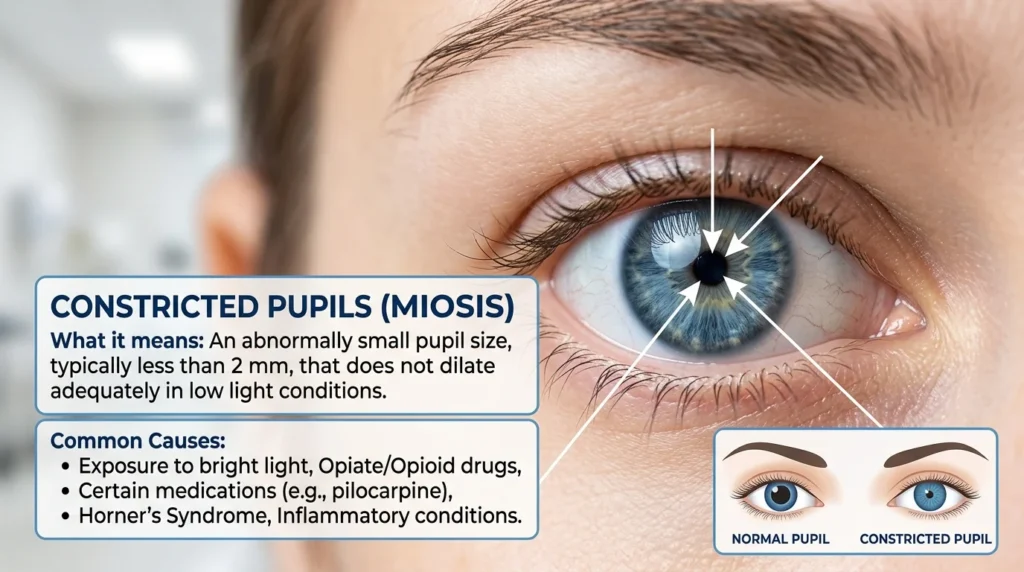
Definition in Simple Words
In everyday language, constricted pupils simply means small pupils.
For example:
“The doctor noticed that the patient’s pupils were constricted.”
This means the doctor observed that the pupils were unusually small.
A useful way to remember the difference is:
- Constricted pupils = smaller pupils
- Dilated pupils = larger pupils
- Miosis = medical term for unusually small or constricted pupils
- Mydriasis = medical term for unusually large or dilated pupils
Pronunciation
Constricted pupils
- Constricted: /kənˈstrɪk.tɪd/
- Pupils: /ˈpjuː.pəlz/
- Approximate pronunciation: “kuhn-STRIK-tid PYOO-pulz”
- Part of speech: adjective + noun
- Medical term: miosis
- Miosis pronunciation: /maɪˈoʊ.sɪs/
Constricted describes the pupils as having become smaller or narrowed.
Origin and Etymology
The word constricted comes from the verb constrict, meaning to tighten, narrow, or make smaller. It ultimately derives from Latin constringere, meaning “to bind tightly” or “draw together.”
Pupil comes through Middle English and Old French from Latin pupilla, a diminutive form associated with a little girl or doll. The word came to refer to the pupil of the eye because a tiny reflection of oneself can appear in another person’s eye.
The medical term miosis comes from Greek myein, meaning “to close the eyes” or “to close.”
The opposite medical condition, unusually enlarged pupils, is called mydriasis.
Meaning in Different Contexts
Constricted Pupils in Everyday Conversation
In everyday language, people usually say small pupils rather than constricted pupils.
For example:
“His pupils look very small.”
“Constricted pupils” sounds more medical or clinical.
Constricted Pupils in Medicine
In medicine, constricted pupils are called miosis.
Healthcare professionals may examine pupil size and reaction to light as part of a neurological or eye examination. Persistent miosis can have many possible causes, so pupil size alone does not identify a specific diagnosis.
Constricted Pupils and Light
Pupils normally constrict when exposed to bright light.
This is a normal protective response that reduces the amount of light entering the eye. The pupils normally become larger in dim conditions to allow more light into the eye.
Therefore, small pupils in bright sunlight are generally normal.
The concern is more about pupils that remain unusually small when they should enlarge or when constriction occurs together with other symptoms.
Constricted Pupils and Medications
Some medications can cause miosis. Cleveland Clinic lists opioids, barbiturates, pilocarpine, clonidine, and other alpha-2 agonists among possible medication-related causes.
A person should not assume that small pupils automatically mean medication misuse. A prescribed medication or an eye medication can also affect pupil size.
Constricted Pupils and Opioids
Opioid exposure is a well-known cause of very small or “pinpoint” pupils.
However, pupil size by itself cannot establish that someone has taken an opioid. Other symptoms and the person’s medical circumstances must be considered.
If someone with suspected opioid exposure is difficult to wake, breathing slowly or irregularly, or otherwise seriously unwell, emergency medical care is needed.
Constricted Pupils and Eye Conditions
Eye inflammation, including uveitis or iritis, can interfere with normal pupil behavior. Eye surgery can also sometimes affect pupil size or reaction.
Constricted Pupils and Neurological Conditions
The nerves controlling the pupils can be affected by neurological problems.
For example, Horner syndrome can cause a constricted pupil on one side, often accompanied by a drooping eyelid and reduced sweating on that side of the face.
Brain injury and stroke can also affect pupil size and function.
Constricted Pupils and Aging
Pupils can naturally become smaller as people age. MedlinePlus notes that by around age 60, pupils may be approximately one-third the size they were at age 20 and may respond more slowly to changes in light.
This does not mean every case of small pupils in an older adult is harmless. A new or unexplained change should still be evaluated appropriately.
Constricted Pupils in Eye Examinations
Doctors may examine pupil size, symmetry, and response to light because these observations can provide information about the eyes and nervous system.
The pupils normally respond together when light is directed into one eye. Abnormal responses can sometimes indicate problems involving the retina, optic nerve, nerves controlling the pupil, or brain.
Examples
- A person’s pupils become small when they walk into bright sunlight.
- A doctor notices unusually small pupils during an examination.
- A medication causes a patient’s pupils to become constricted.
- A person with an eye inflammation develops abnormal pupil constriction.
- One pupil appears smaller than the other.
- An older adult develops smaller pupils as part of normal aging.
- A patient has constricted pupils after taking certain medications.
- A person with Horner syndrome has a smaller pupil on one side.
- A patient develops small pupils after a neurological injury.
- A healthcare provider records miosis during a physical examination.
- A person has small pupils in bright daylight, which can be a normal response.
- A patient’s pupils remain unusually small after moving into a dark room.
- An eye specialist checks whether the pupils respond normally to light.
- A doctor investigates sudden changes in pupil size after a head injury.
- A medical report describes the patient’s pupils as “constricted.”
- A patient asks whether small pupils are a side effect of a new medication.
- A healthcare provider compares the size of both pupils.
- A person notices a new difference in pupil size and seeks medical advice.
- A neurological examination includes assessment of pupil responses.
- A doctor distinguishes normal light-related constriction from persistent miosis.
Example Sentences
- The doctor observed that the patient’s pupils were constricted.
- Constricted pupils are medically known as miosis.
- The pupils normally constrict in bright light.
- Her pupils became smaller when she stepped outside.
- The nurse documented constricted pupils during the examination.
- The medication may cause the pupils to become constricted.
- His pupils remained unusually small even in a dim room.
- The doctor checked whether both pupils reacted normally to light.
- Constricted pupils can have several possible causes.
- Small pupils do not always indicate a serious medical problem.
- The patient’s pupils were constricted after the eye examination.
- The doctor asked whether the patient had recently started a new medication.
- The pupils were small but responded normally to light.
- One pupil was noticeably more constricted than the other.
- The physician evaluated the patient’s pupil responses.
- Bright light caused the pupils to constrict normally.
- Persistent miosis may require evaluation to determine its cause.
- The report described the patient’s pupils as small and constricted.
- The doctor explained that pupil size can change naturally with lighting.
- Constricted pupils may occur for reasons ranging from normal light responses to medical conditions.
- The patient noticed a sudden change in pupil size.
- The ophthalmologist examined the pupils for differences in size and reaction.
- The nurse recorded the pupil findings in the patient’s chart.
- The doctor explained that medication can sometimes affect pupil size.
- The patient’s pupils became smaller as the light level increased.
Synonyms
There are several related terms, although they are not all exact synonyms.
Small Pupils
The simplest everyday expression for constricted pupils.
Miosis
The medical term for unusually small or constricted pupils.
Pinpoint Pupils
A descriptive expression for extremely small pupils. It is often used when the pupils are very small, but it does not identify the cause.
Narrowed Pupils
A plain-English description that is similar to constricted pupils.
Contracted Pupils
Another descriptive expression, although constricted pupils and miosis are more standard in medical writing.
Antonyms
The main opposite of constricted pupils is:
Dilated Pupils
Dilated pupils are larger than usual.
The medical term for excessive or abnormal pupil dilation is mydriasis.
Other contrasting expressions include:
- Large pupils — everyday description of pupils that have increased in size.
- Enlarged pupils — descriptive term for larger-than-usual pupils.
- Dilated pupils — the standard medical and everyday term.
- Mydriasis — medical term for excessive pupil dilation.
Similar or Commonly Confused Words
Constricted Pupils vs. Dilated Pupils
These are opposites.
Constricted pupils are smaller.
Dilated pupils are larger.
Miosis vs. Mydriasis
Miosis refers to unusually small or constricted pupils.
Mydriasis refers to unusually large or dilated pupils.
Constricted Pupils vs. Unequal Pupils
These are not the same thing.
Constricted pupils means the pupils are small.
Unequal pupils means the two pupils are different sizes. The medical term for unequal pupil size is anisocoria.
A person can have:
- Both pupils constricted equally.
- One pupil constricted more than the other.
- Unequal pupils without both being unusually constricted.
Miosis vs. Anisocoria
Miosis describes pupil size that is unusually small.
Anisocoria describes a difference in size between the two pupils.
They describe different characteristics.
Pinpoint Pupils vs. Miosis
“Pinpoint pupils” is a descriptive phrase for extremely small pupils.
Miosis is the medical term for constricted or unusually small pupils.
The two expressions can refer to the same physical finding, but “pinpoint pupils” is less specific medically.
Common Mistakes
Assuming Small Pupils Always Mean a Medical Problem
Pupils naturally become smaller in bright light. Therefore, seeing small pupils in strong light is not automatically abnormal.
Assuming Constricted Pupils Always Mean Opioid Use
Opioids can cause miosis, but they are only one possible cause. Medication effects, eye disorders, neurological conditions, aging, and other factors can also produce small pupils.
Confusing Miosis With Anisocoria
Miosis means unusually small pupils.
Anisocoria means unequal pupil size.
They are not interchangeable terms.
Assuming Both Pupils Must Be Constricted
Miosis can affect one eye or both eyes.
Assuming Pupil Size Alone Gives a Diagnosis
Pupil size is only one clinical finding. Healthcare professionals consider other symptoms, medications, medical history, pupil reactions, and examination findings when determining the cause.
Stopping Medication Without Medical Advice
If constricted pupils appear after starting or changing medication, the medication could be contributing. However, prescribed medication should not be stopped or changed without advice from the prescribing healthcare professional.
Ignoring Sudden Changes
A sudden unexplained change in pupil size, especially when accompanied by vision problems, severe headache, eye pain, confusion, weakness, or a recent head injury, should receive prompt medical evaluation.
When and How to Use This Word
Constricted pupils is primarily a medical and clinical expression.
It is appropriate in:
- Medical reports
- Eye examinations
- Nursing documentation
- Neurological examinations
- Health articles
- Medical conversations
- Scientific writing
- Patient education
In ordinary conversation, small pupils is more natural.
For example:
Clinical:
“The patient presented with constricted pupils.”
Everyday:
“His pupils looked very small.”
The phrase constricted pupils is descriptive. It does not, by itself, explain why the pupils are small.
Related Expressions
- Miosis — medical term for constricted or unusually small pupils.
- Pinpoint pupils — very small pupils.
- Pupil constriction — the process of the pupil becoming smaller.
- Pupil dilation — the process of the pupil becoming larger.
- Dilated pupils — unusually large pupils.
- Mydriasis — medical term for excessive pupil dilation.
- Anisocoria — unequal pupil sizes.
- Pupil response to light — how pupils change when exposed to light.
- Pupillary reflex — the automatic response of the pupils to light.
- Horner syndrome — a condition that can cause a constricted pupil on one side, often with eyelid drooping and reduced sweating.
- Iritis — inflammation of the iris that can affect pupil behavior.
- Uveitis — inflammation involving structures inside the eye that can affect pupil function.