
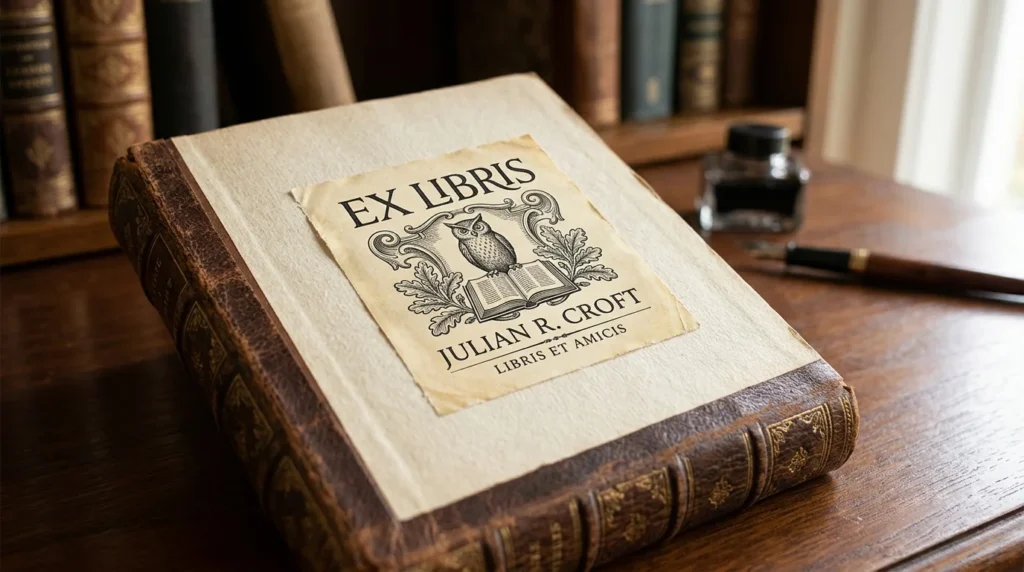
Definition in Simple Words
In everyday language, an ex libris is basically an owner’s label for a book.
It tells you:
“This book comes from the library or collection of this person.”
For example, if a book contains a decorative label saying “Ex Libris Maria Khan,” it indicates that the book was part of Maria Khan’s personal library or collection.
It does not necessarily mean that the person who owns the book today is the person named on the ex libris plate. The book may have been sold, inherited, donated, or otherwise passed to another owner.
Pronunciation
Ex libris is a Latin phrase commonly pronounced in English approximately as eks LIB-riss.
- Part of speech: Latin phrase used as a noun or adjective in English
- Language: Latin
- Literal meaning: “from the books of”
- Common book-related meaning: A mark identifying a book’s owner or collection
Because it is a Latin expression used in English, pronunciation can vary somewhat among speakers.
Origin and Etymology
Ex libris comes from Latin.
- ex means “from” or “out of”
- libris is the ablative plural form of liber, meaning “book”
Thus, ex libris literally means “from the books” or, in the traditional ownership formula, “from the books of…”
The phrase became associated with bookplates, particularly printed labels identifying individual book owners and private libraries.
Early forms of ownership marks existed long before modern printed bookplates. As printing and book ownership expanded in Europe, decorative ownership labels became increasingly popular. Ex libris plates eventually developed into a form of miniature graphic art.
Meaning in Different Contexts
Books and Libraries
In the context of books, ex libris primarily identifies ownership.
An ex libris plate may contain:
- The owner’s name
- A family name
- A library name
- A coat of arms
- Initials
- A personal motto
- Decorative artwork
- A date or other identifying information
Book Collecting
For collectors, an ex libris plate can provide valuable information about a book’s provenance, meaning its history of ownership.
A book that once belonged to a famous scholar, author, politician, aristocratic family, or important private library may attract additional interest from collectors.
However, an ex libris plate does not automatically make a book rare or valuable. Its significance depends on factors such as the identity of the former owner, the book’s rarity, condition, edition, provenance, and market demand.
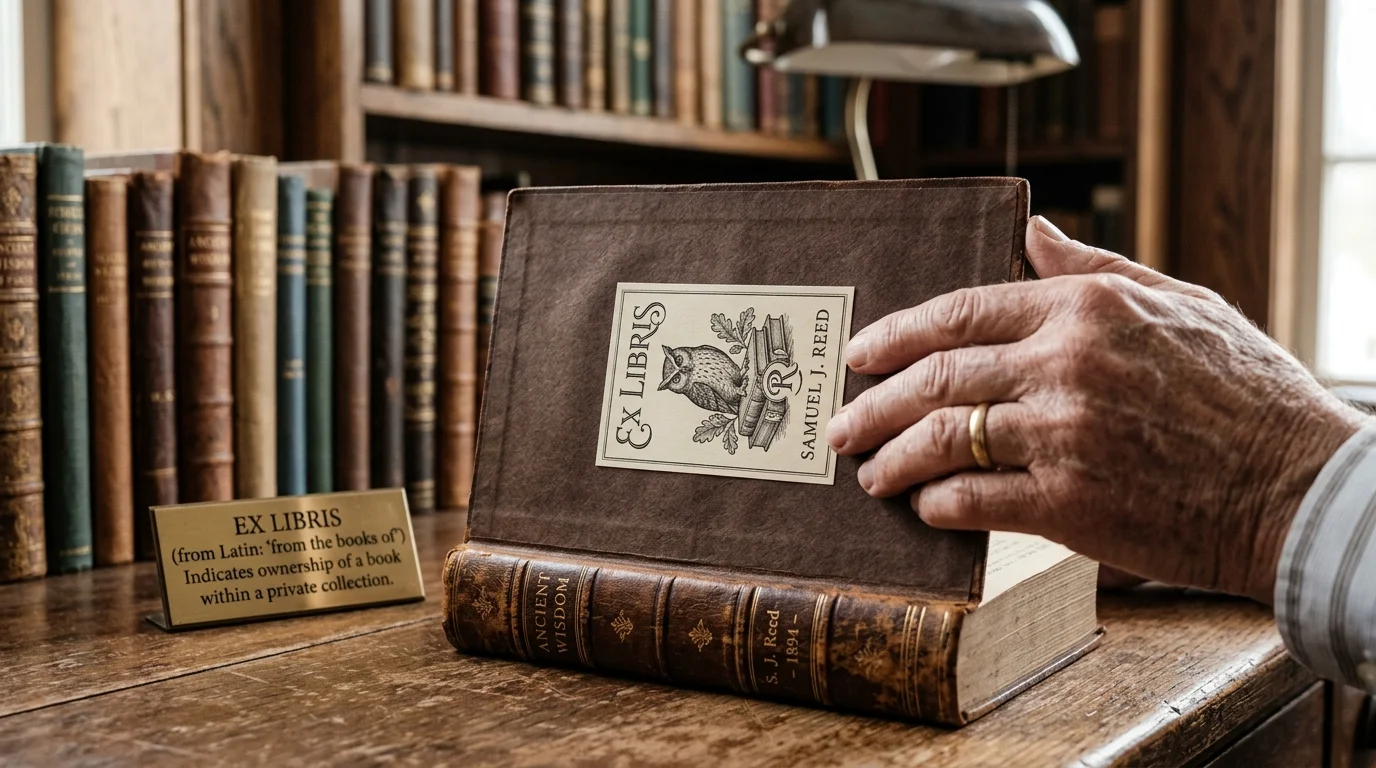
Antiquarian Books
In an old or antique book, an ex libris inscription can help researchers determine who previously owned the volume.
For example, an old scientific book containing the bookplate of a notable scientist may provide evidence that the volume was once part of that person’s personal library.
Art and Design
Ex libris plates are also considered a form of graphic art.
Some were created by professional artists and printmakers. Collectors may therefore be interested in the plate itself, independently of the book in which it appears.
Family History
An inherited book bearing an ex libris plate can sometimes provide clues about a family’s reading habits, intellectual interests, social connections, or history of ownership.
Personal Libraries
People sometimes use ex libris labels simply as elegant personalized ownership marks.
Modern versions can be purchased or custom-designed with a person’s name and preferred artwork.
Examples
Here are practical examples of how ex libris appears in books:
- A bookplate says “Ex Libris Robert Brown.”
- A family places an ex libris label inside every book in its home library.
- An antique book contains an engraved ex libris plate from a previous owner.
- A collector discovers an ex libris mark belonging to a well-known author.
- A university professor uses a personalized ex libris stamp in academic books.
- A family crest appears above the words “Ex Libris.”
- A book contains a handwritten Ex Libris inscription rather than a printed plate.
- An antiquarian studies an ex libris plate to investigate a book’s provenance.
- A collector purchases an illustrated ex libris plate as a piece of graphic art.
- A donated library may place an ex libris mark identifying the institution.
- A person gives custom ex libris bookplates as a gift to an avid reader.
- A rare book contains several ownership marks from different periods.
- A librarian finds an ex libris plate identifying a previous private collection.
- A book collector catalogs volumes according to their previous owners.
- An artist designs a personalized ex libris plate featuring a reader’s favorite symbol.
- A historical book bears the coat of arms of its former owner.
- A secondhand book contains an old ex libris sticker inside its cover.
- A researcher uses an ownership plate as one piece of evidence in tracing provenance.
Example Sentences
- The antique book contains an elegant ex libris plate.
- The inscription identifies the original owner of the volume.
- I found an ex libris label inside the front cover.
- The book bears the ex libris mark of a nineteenth-century collector.
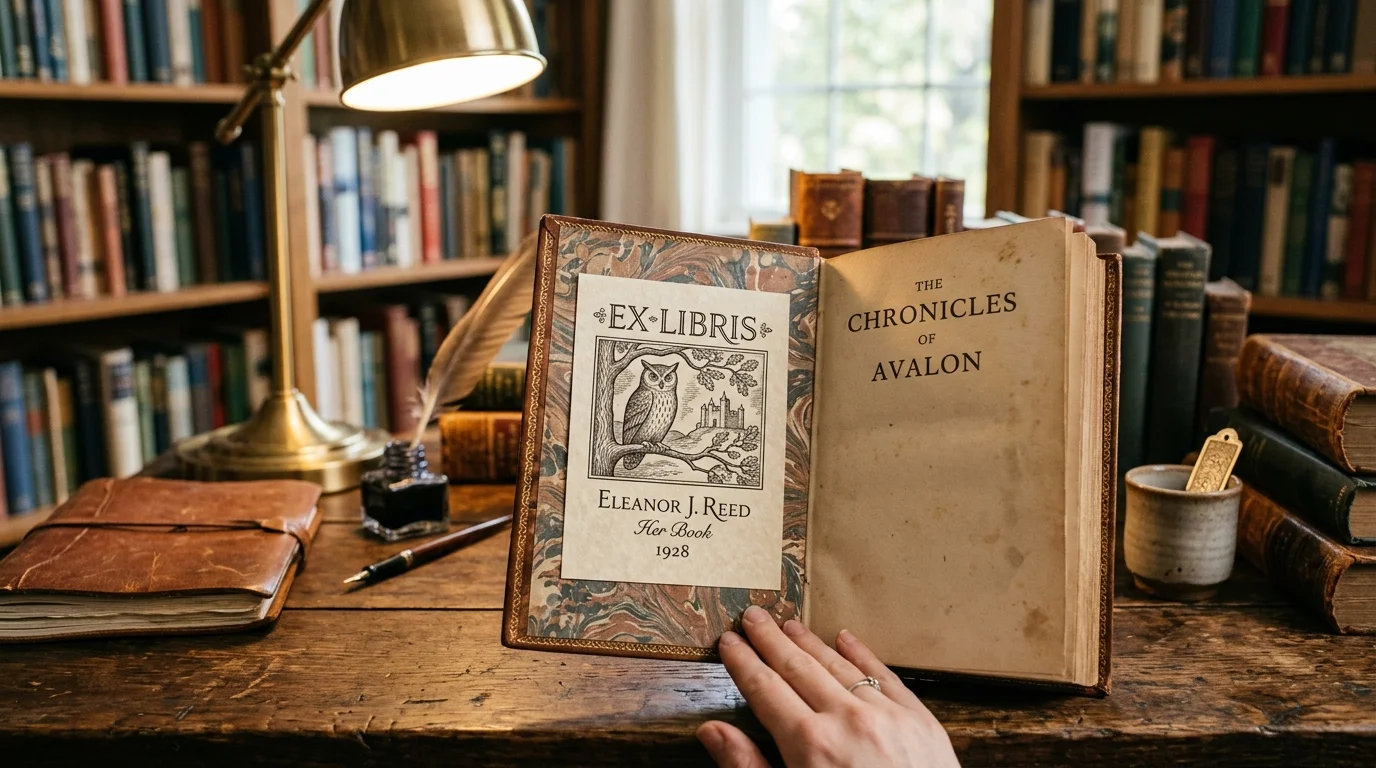
- Her personalized ex libris plate features a small owl.
- The librarian recognized the family’s distinctive ex libris design.
- An ex libris plate can provide clues about a book’s ownership history.
- The collector carefully preserved the original ex libris label.
- The old volume has an engraved ex libris bookplate.
- His library books were marked with a simple ex libris stamp.
- The ex libris inscription identifies the book as part of a private collection.
- The researcher examined the ex libris plate for information about provenance.
- The book’s ornate ex libris design was created by a local artist.
- She inherited several books bearing her grandfather’s ex libris plates.
- The seller mentioned the former owner’s ex libris mark in the description.
- An ex libris plate can be both decorative and informative.
- The family crest appears prominently on the ex libris bookplate.
- The rare volume retains its original owner’s ex libris label.
- The bookseller photographed the ex libris plate for the catalog.
- The phrase ex libris literally refers to books belonging to a particular collection.
Synonyms
There is no exact English synonym for ex libris, but several expressions convey a similar meaning.
- Bookplate — the closest standard English term; a printed or decorative ownership label placed in a book.
- Ownership label — emphasizes the purpose of identifying the owner.
- Library label — may identify a personal or institutional collection.
- Ownership mark — a broader term covering labels, stamps, signatures, and inscriptions.
- Book owner’s mark — an informal descriptive expression.
- Provenance mark — emphasizes evidence of a book’s ownership history rather than simply current ownership.
Bookplate is generally the best English equivalent when referring specifically to a physical ex libris label.
Antonyms
Ex libris does not have a direct antonym because it is an ownership expression rather than a quality that naturally has an opposite.
Depending on context, contrasting concepts include:
- Unmarked book — a book with no identifiable ownership mark.
- Anonymous ownership — ownership where the owner’s identity is unknown.
- Public-domain library marking — an institutional context rather than a personal ownership mark.
- No provenance — a book for which ownership history cannot be established.
These are contextual contrasts, not true linguistic antonyms.
Similar or Commonly Confused Words
Ex Libris vs. Bookplate
These terms are closely related.
Ex libris is the traditional Latin phrase commonly printed on an ownership plate.
Bookplate is the English term for the physical label itself.
Therefore, an ex libris can be a type of bookplate.
Ex Libris vs. Ex-Libris
You may encounter both ex libris and ex-libris.
Ex libris is the standard Latin phrase, generally written as two words.
Ex-libris may appear as an English adjective or in specialized collecting terminology.
Ex Libris vs. Book Stamp
A book stamp is usually an ownership or library stamp applied directly to a page or cover.
An ex libris is traditionally a printed or engraved bookplate, although modern ex libris marks can take many forms.
Ex Libris vs. Book Signature
A book signature generally refers to the owner’s handwritten name or signature.
An ex libris plate is a more deliberately designed ownership mark.
Ex Libris vs. Provenance
Ex libris is an ownership mark.
Provenance is the broader history of where an object came from and who owned it over time.
An ex libris plate can therefore be evidence of provenance, but the two terms do not mean the same thing.
Common Mistakes
Thinking Ex Libris Means “Rare Book”
It does not.
An ex libris mark simply indicates an ownership connection. It does not automatically indicate that the book is rare or expensive.
Assuming the Named Person Is the Current Owner
Not necessarily.
The book may have changed hands since the ex libris plate was added.
Assuming Every Ex Libris Plate Is Valuable
Some ex libris plates are collectible works of art, but many are ordinary personalized labels. Their value depends on factors such as artistic significance, rarity, creator, historical importance, and collector interest.
Confusing Ex Libris With a Publisher’s Mark
An ex libris mark identifies an owner or collection. A publisher’s mark identifies the publisher or printing house.
Assuming the Phrase Is English
Ex libris is Latin, although it is widely used in English-language book collecting and library terminology.
When and How to Use This Word
Ex libris is a specialized but well-established term associated with:
- Books
- Libraries
- Book collecting
- Antiquarian books
- Bibliography
- Provenance research
- Graphic arts
- Personal libraries
It is more formal and specialized than simply saying “bookplate” or “ownership label.”
If you are speaking to a general audience, bookplate may be clearer. If discussing historical books, collecting, or bibliographic terminology, ex libris is entirely appropriate.
For example:
General: “There is a bookplate inside the cover.”
Specialized: “The volume retains its original ex libris.”
Related Expressions
- Bookplate — a label identifying the owner of a book.
- Provenance — the documented history of an object’s ownership.
- Private library — a collection of books belonging to an individual or private organization.
- Personal collection — books or other objects collected by an individual.
- Ownership mark — any mark indicating who owns or owned an item.
- Book collector — someone who collects books, often according to particular themes or criteria.
- Antiquarian book — an old or historically significant book, especially one of interest to collectors.
- Bibliophile — a person who loves books, particularly as objects of interest or collection.
- Armorial bookplate — an ex libris bookplate featuring a coat of arms.
- Provenance research — investigation into an object’s ownership and history.