

Definition in Simple Words
In simple English, née means “born with the surname” or “formerly known by this surname.”
For example:
Maria Lopez, née Garcia
means:
Maria Lopez was born Maria Garcia.
The important point is that née introduces a person’s earlier surname, most commonly the surname they had at birth.
Pronunciation
Née
- Pronunciation: /neɪ/
- Approximate pronunciation: “nay”
- Language: French
- Part of speech: adjective used in English as a name-related term
- Meaning: born; originally named
Né is the masculine form and is also pronounced approximately “nay.”
The accent mark in née is important because it distinguishes the word from the ordinary English word “nee,” although “nee” is sometimes written without the accent in informal English.
Origin and Etymology
Née comes directly from French.
In French:
- né = born, masculine
- née = born, feminine
Both forms come from the French verb naître, meaning “to be born.”
English adopted née as a way to indicate a woman’s surname at birth or a previous surname.
The expression has historically been especially useful when someone’s surname changed, most commonly because of marriage.
Meaning in Different Contexts
Née in Family Names
The most common use is to identify a woman’s surname before marriage.
For example:
Anna Wilson, née Carter
means Anna’s current surname is Wilson and her birth surname was Carter.
This usage is especially common in biographies and family histories.
Née in Genealogy
Genealogists frequently encounter née when researching family histories.
For example:
Margaret Adams, née Thompson
can help distinguish Margaret’s birth family from her married family.
Knowing a person’s née surname can be useful when tracing:
- Birth records
- Marriage records
- Family trees
- Census records
- Historical documents
- Ancestry records
Née in Biographies
Biographies may use née to clarify someone’s original surname.
For example:
The author Helen Brown, née Davis, was born in London.
This tells readers that Davis was her surname at birth.
Née in Historical Writing
Historical sources sometimes use née when a woman is better known by a married surname but researchers want to identify her family of origin.
For example:
Mary Johnson, née Wilson
makes the relationship between her current and birth surnames clear.
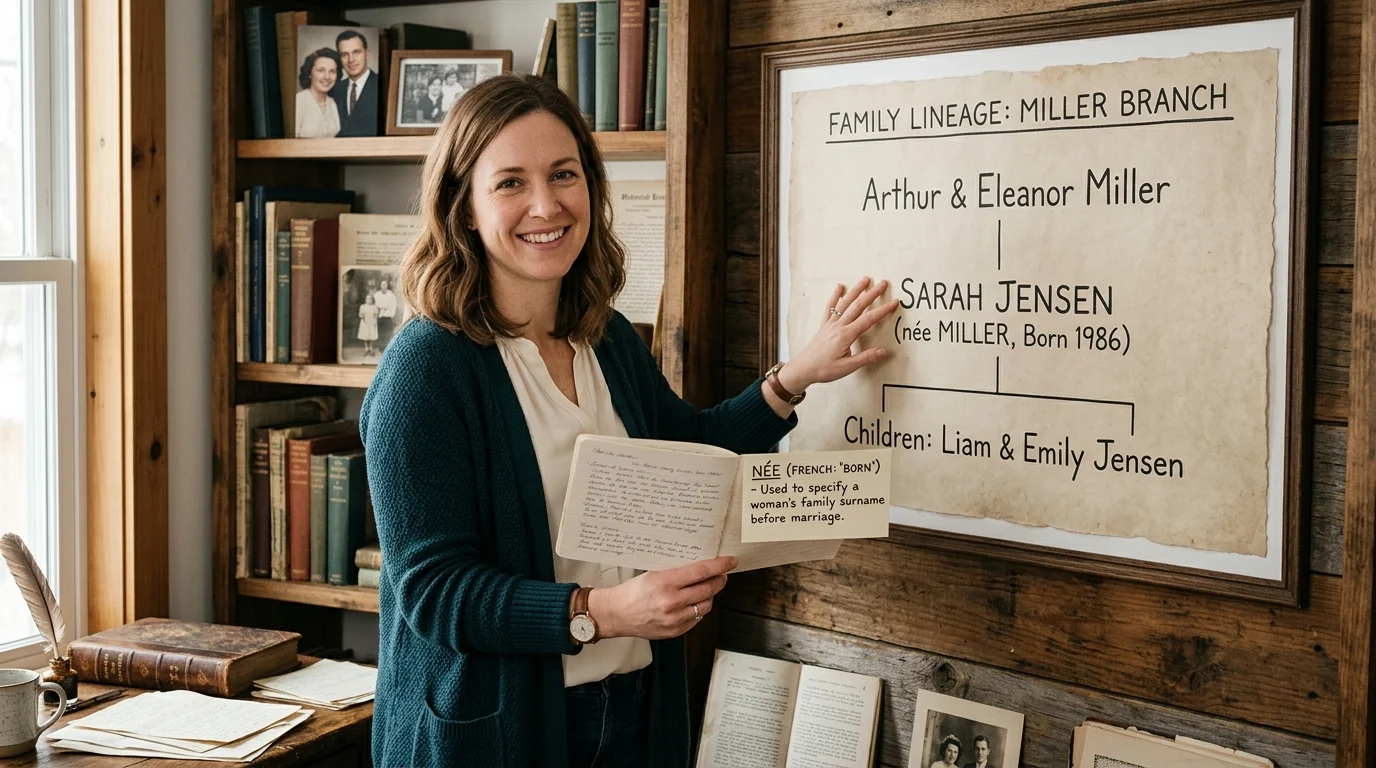
Née in Professional Writing
In formal writing, née can be used when knowing a person’s previous surname is relevant.
For example:
Dr. Sarah Ahmed, née Khan
This indicates that Khan was her surname at birth.
However, it should not be added merely because a person once had another surname. The previous name should be relevant to the context.
Née in Modern Usage
Although traditionally used for women’s birth surnames, modern English usage is not always limited to marriage.
Some writers use née more broadly to identify a former or original name.
For example:
The company was founded under a different name, née ABC Technologies.
This broader usage is sometimes seen, although the traditional use relates to a person’s original surname.
For clarity, formerly known as or originally called may be better alternatives when discussing organizations or things rather than people.
Née and Marriage
The most familiar use of née is connected to marriage.
For example:
Emily Smith, née Taylor
means Emily’s surname is now Smith, while Taylor was her surname at birth.
However, not everyone changes their surname after marriage, and surname practices vary widely across cultures and individuals.
Therefore, née should be used only when it accurately describes the person’s previous or birth surname.
Née and Birth Names
A birth surname is the surname a person had at birth.
A née surname traditionally identifies that surname in a person’s name.
For example:
Current name: Olivia Carter
Birth surname: Olivia Brown
Formal reference: Olivia Carter, née Brown
The term is especially useful when a person’s current surname differs from their surname at birth.
Examples
- Maria Lopez, née Garcia, was born in Madrid.
- The biography identifies Anna Brown, née Wilson.
- Sarah Jones, née Davis, changed her surname after marriage.
- The family tree lists Elizabeth Smith, née Carter.
- The historical record refers to Margaret White, née Evans.
- The author was born Helen Taylor, née Morgan.
- Jane Anderson, née Lewis, was the eldest daughter.
- The document identifies the woman as Clara Robinson, née Adams.
- Researchers discovered that Mary Green was née Walker.
- The article refers to Susan Miller, née Clark.
- The genealogist recorded Emily Harris, née Thomas.
- The historical figure was born Catherine Wilson, née Baker.
- The obituary identifies her as Laura Johnson, née Martin.
- The family records list Sarah Brown, née Cooper.
- The biography uses the phrase “Anne Davis, née Roberts.”
- The marriage record provides her former surname.
- The historian explains that the woman’s birth surname was Edwards.
- The genealogy book identifies Margaret Hall, née Turner.
- The writer was born under a different surname.
- The family history records her as Elizabeth King, née Morris.
Example Sentences
- Jane Smith, née Brown, was born in 1950.
- The biography identifies the author’s birth surname as Taylor.
- Maria Lopez, née Garcia, moved to the United States as a young woman.
- The family tree lists Sarah Wilson, née Davis.
- The historian refers to Elizabeth Jones, née Carter.
- Her surname at birth was Miller.
- The document identifies her as Anna Brown, née Lewis.
- The genealogist found records for Margaret Green, née Adams.
- The author was born Helen Clark, née Roberts.
- The obituary describes her as Susan White, née Thomas.
- The historical record gives her name as Mary Johnson, née Wilson.
- Researchers confirmed that her birth surname was Evans.
- The family history mentions Caroline Smith, née Walker.
- The article identifies the woman as Laura Davis, née Martin.
- Her maiden name was Baker, although her legal surname later changed.
- The genealogist used née to distinguish her birth surname from her married surname.
- The biography gives her full name as Elizabeth Brown, née Cooper.
- Her original surname appears in several historical records.
- The marriage record confirms that she was born Sarah Adams.
- The writer’s surname at birth was Harrison.
Synonyms
There is no exact English synonym for née, but several expressions convey a similar meaning.
Birth Surname
The surname a person had at birth.
Maiden Name
Traditionally, a woman’s surname before marriage.
Birth Name
The name given to a person at birth, which can include both given name and surname.
Former Surname
A surname a person used previously.
Original Surname
The surname a person originally had.
Formerly Known As
A broader phrase used to identify an earlier name.
Antonyms
Née does not have a true antonym because it identifies a relationship between a person’s current and former names.
Depending on context, contrasting concepts include:
Current Surname
The surname a person currently uses.
Married Surname
A surname adopted after marriage, when applicable.
Present Name
The name a person currently uses.
Similar or Commonly Confused Words
Née vs. Né
Both words mean “born” in French.
Née is traditionally the feminine form.
Né is traditionally the masculine form.
Examples:
Maria Brown, née Smith
John Brown, né Smith
In modern English, however, usage can be less rigid than traditional French grammar.
Née vs. Maiden Name
These concepts often overlap.
Née is a word used in a construction such as:
Jane Smith, née Brown.
Maiden name is the English noun phrase traditionally referring to a woman’s surname before marriage.
“Née” can sometimes be preferable in formal biographical writing, while “maiden name” is more familiar in everyday English.
Née vs. Birth Name
Birth name is broader.
It can refer to the entire name a person had at birth.
Née traditionally identifies a former or birth surname.
Née vs. Former Surname
Former surname is more direct and gender-neutral.
It can refer to any previous surname regardless of why it changed.
Née vs. Formerly Known As
Formerly known as can describe changes to first names, surnames, stage names, company names, titles, and other names.
Née is traditionally associated with birth or original surnames.
Common Mistakes
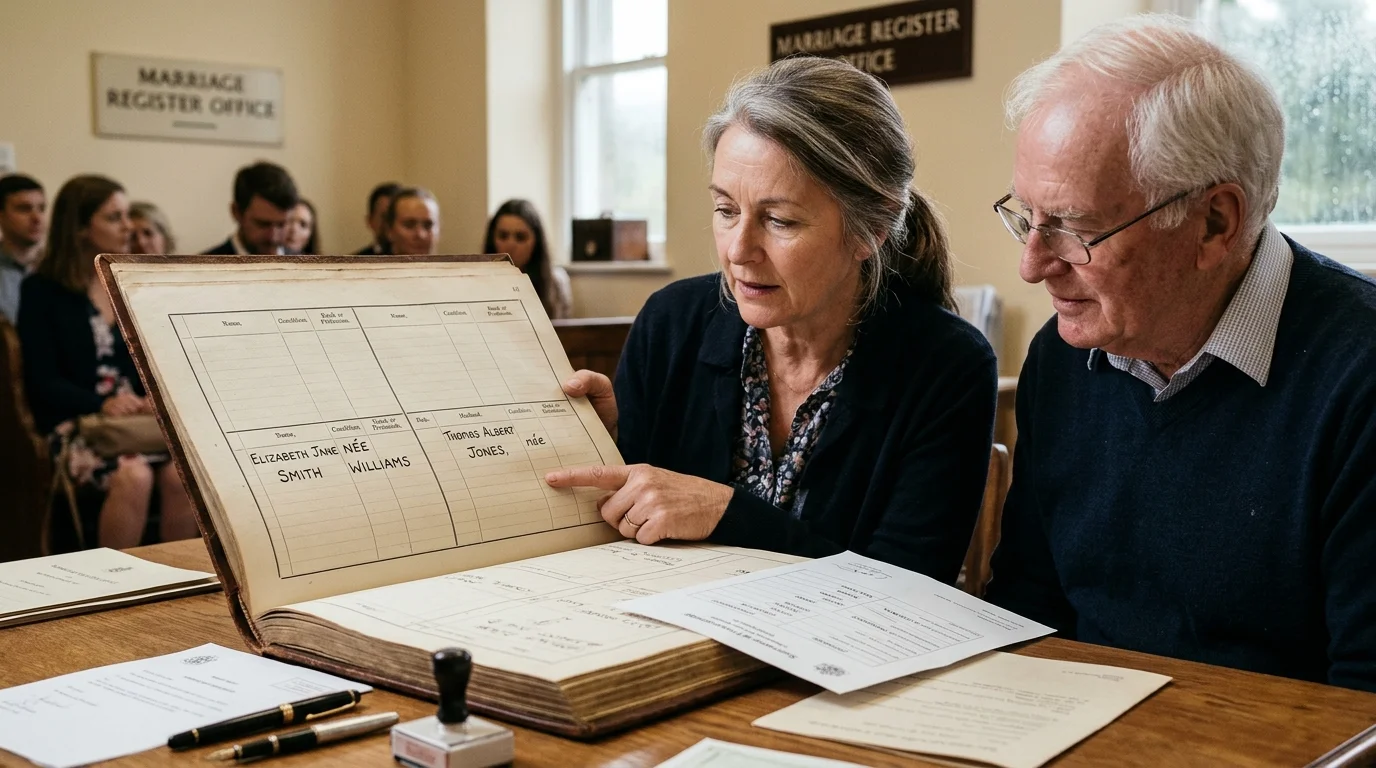
Thinking Née Means Married Name
It is the opposite in the traditional usage.
Née identifies the earlier or birth surname, not the surname adopted after marriage.
Pronouncing Née Like “Knee”
In English, née is generally pronounced like “nay,” not like the body part “knee.”
Using Née Before a First Name
The traditional construction is associated with a surname.
For example:
Sarah Brown, née Smith
not:
née Sarah
Assuming Née Always Refers to Marriage
Although marriage is the most common context, the broader idea is identifying a person’s original or former surname.
Assuming Every Woman Has a Maiden Name
Not everyone changes their surname after marriage, and naming practices vary across cultures and individuals.
Assuming Née Is Only Used in French
The word is French in origin but is commonly used as a borrowed term in English.
Confusing Née With “Formerly Known As”
The two can overlap in meaning, but née traditionally has a specific connection with a person’s original or birth surname.
When and How to Use This Word
Née is relatively formal and is most commonly found in:
- Biographies
- Genealogy
- Historical writing
- Obituaries
- Family histories
- Formal profiles
- Academic writing
- Newspaper writing
The standard construction is:
Current surname, née former surname
For example:
Laura Wilson, née Carter
This means Laura’s surname is now Wilson, while Carter was her surname at birth.
In everyday conversation, most people would probably say:
“Her maiden name was Carter.”
rather than:
“She was née Carter.”
The latter sounds formal and is less conversational.
Related Expressions
Maiden Name
A woman’s surname before marriage, traditionally.
Birth Surname
The surname a person had at birth.
Birth Name
The name given to someone at birth.
Former Name
A name previously used by a person or organization.
Former Surname
A surname previously used by a person.
Married Name
A surname adopted after marriage, when applicable.
Né
The masculine French form corresponding to née.
Name at Birth
The name recorded for a person at birth.
Family Name
Another term for surname or last name.
Surname
A family name shared or inherited within a family.