
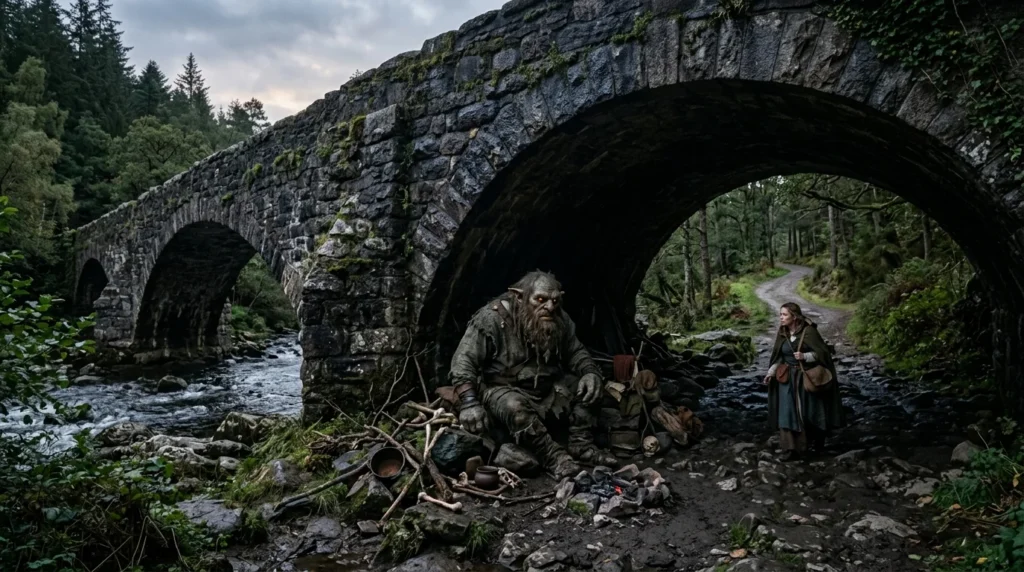
Definition in Simple Words
In simple English, a troll under the bridge is:
A mythical creature that lives beneath a bridge and troubles people who try to cross it.
In modern figurative language, it can mean:
A person who causes trouble, acts unpleasantly, or seems to hide away while creating problems for others.
For example:
“He acts like a troll under the bridge, complaining about everyone who comes near him.”
Here, the speaker is not talking about a real monster. The phrase is being used humorously to describe someone’s behavior.
Pronunciation
Troll under the bridge
- Pronunciation: /troʊl ˈʌndər ðə brɪdʒ/
- Approximate pronunciation: “trohl UN-der thuh brij”
- Part of speech: noun phrase
- Plural: trolls under bridges
Troll can function as a noun or verb in modern English.
As a noun, it can mean a mythical creature or, in modern internet language, a person who deliberately provokes others online.
Origin and Etymology
The word troll has a long history in Scandinavian and Germanic folklore. Trolls are supernatural beings commonly associated with mountains, forests, caves, and other remote places.
The specific image of a troll living under a bridge is strongly associated with Scandinavian-influenced fairy tales and children’s folklore.
The phrase became especially familiar to English-speaking audiences through “The Three Billy Goats Gruff,” a Norwegian fairy tale collected and published by Peter Christen Asbjørnsen and Jørgen Moe in the 19th century.
In the story, a threatening troll lives beneath a bridge and tries to stop three goats from crossing it.
The modern expression is therefore strongly connected with the broader folklore tradition of a dangerous or unpleasant creature guarding a passage.
The exact origins of individual troll traditions are complex, and different cultures have their own versions of supernatural beings resembling trolls. Therefore, it is more accurate to discuss a broad folklore tradition rather than claim that every bridge-troll story originated from one specific source.

Meaning in Different Contexts
Troll Under a Bridge in Folklore
In traditional folklore, a bridge troll is a supernatural creature associated with a bridge.
The troll may:
- Demand payment
- Threaten travelers
- Ask riddles
- Guard a passage
- Eat or frighten travelers
- Prevent people from crossing
- Be defeated through cleverness
The bridge often represents a boundary between two places, making the troll a symbolic obstacle that travelers must overcome.
Troll Under a Bridge in Fairy Tales
In fairy tales, the troll is often an antagonist.
The creature creates a problem for the main characters, who must use courage, intelligence, cooperation, or trickery to get past it.
“The Three Billy Goats Gruff” is the classic example.
Troll Under a Bridge in Children’s Stories
Children’s books frequently portray bridge trolls as exaggerated fantasy characters.
They may be frightening but are often made humorous rather than genuinely terrifying.
A children’s story might depict a troll with:
- Huge teeth
- Messy hair
- A large nose
- A deep voice
- A bad temper
- A ridiculous personality
Troll Under a Bridge as a Metaphor
The phrase can metaphorically describe someone who creates obstacles for others.
For example:
“The office troll under the bridge rejected every proposal.”
The speaker is humorously comparing a difficult person to a fantasy troll guarding a bridge.
Troll Under a Bridge in Modern Internet Language
The word troll has developed a separate modern meaning online.
An internet troll is someone who deliberately posts provocative, offensive, misleading, or inflammatory material to get a reaction from other people.
However, “troll under the bridge” is not the standard technical term for an internet troll.
It is usually a playful combination of the traditional folklore image with the modern meaning of troll.
Troll Under a Bridge in Business
In business or workplace conversation, someone might jokingly call a difficult gatekeeper a “troll under the bridge.”
For example, if an employee must get approval from someone who constantly creates unnecessary obstacles, a coworker might say:
“You have to get past the troll under the bridge before the project can move forward.”
The phrase is figurative and humorous.
Troll Under a Bridge in Literature
Writers often use bridge trolls as symbols of obstacles, fear, greed, or challenges.
A bridge itself can symbolize transition or movement from one stage of life to another. The troll then represents something preventing the character from making that transition.
Troll Under a Bridge in Popular Culture
Modern movies, books, games, cartoons, and fantasy stories frequently use trolls as creatures that live underground, under bridges, in caves, or in remote wilderness.
Their personalities vary considerably. Some are terrifying villains, while others are comic characters.
Examples
- A fairy-tale troll hides beneath a wooden bridge.
- A traveler encounters a troll while crossing a mountain bridge.
- Three goats must outsmart a bridge troll.
- A story portrays the troll as a giant creature guarding a river crossing.
- A child imagines a troll living underneath the bridge near the park.
- A fantasy game features a troll that charges travelers a toll.
- A writer uses a bridge troll as a symbol of an obstacle.
- A comedian compares a grumpy neighbor to a troll under a bridge.
- A manager jokingly calls a difficult approval officer a bridge troll.
- A character refuses to cross because a troll is guarding the bridge.
- A cartoon shows a friendly troll living under an old stone bridge.
- A fantasy novel uses a troll to protect a magical bridge.
- A parent tells a child a story about a troll guarding a bridge.
- A traveler tricks the troll and safely crosses the bridge.
- A character describes an unpleasant person as a “troll under the bridge.”
- An online joke combines the folklore troll with the idea of an internet troll.
- A video game requires players to defeat a bridge troll.
- A story uses the troll as a metaphor for fear.
- A bridge troll demands a riddle before allowing travelers to pass.
- A fantasy adventure begins when a group encounters a troll beneath an ancient bridge.
Example Sentences
- The troll under the bridge refused to let the travelers pass.
- According to the story, a giant troll lived beneath the old bridge.
- The children laughed when they saw the cartoon troll under the bridge.
- The knight had to outsmart the troll before crossing the river.
- A troll under the bridge is a familiar image in European-inspired folklore.
- The fairy tale features a frightening troll guarding a bridge.
- The travelers wondered what the troll would demand from them.
- The bridge troll became the main obstacle in the story.
- The children imagined that a troll lived under the bridge near their house.
- The hero defeated the troll and continued across the bridge.
- He joked that his boss was a troll under the bridge guarding every approval.
- She described the difficult reviewer as the troll under the bridge of the project.
- The novel uses the troll as a symbol of an obstacle that must be overcome.
- The troll emerged from beneath the bridge when the travelers approached.
- The goats had to find a clever way past the bridge troll.
- The fantasy game includes a powerful troll guarding an ancient bridge.
- The expression comes from the familiar folklore image of a troll beneath a bridge.
- The troll demanded a toll before allowing anyone to cross.
- The story presents the troll as frightening at first but humorous later.
- Calling someone a troll under the bridge is usually figurative and playful.
- The children wrote a story about a friendly troll under the bridge.
- The travelers heard a strange voice coming from beneath the bridge.
- The troll represented the fear that prevented the hero from moving forward.
- The character behaved like a troll under the bridge, stopping everyone who tried to proceed.
- The old bridge became famous because of the legend of the troll living underneath it.
Synonyms
There is no perfect synonym for troll under the bridge, because the expression combines a specific folklore image with metaphorical meanings.
Bridge Troll
The closest direct expression. It refers specifically to a troll that lives under or near a bridge.
Troll
The shorter form can refer to the mythical creature itself.
Monster
A broader term for a frightening or supernatural creature.
Goblin
A different type of folklore creature that may be mischievous or unpleasant. It is not technically the same as a troll.
Ogre
A large, dangerous humanoid creature commonly found in European fairy tales. Ogres and trolls are related in some modern fantasy contexts but are distinct folklore traditions.
Guardian
A neutral term for a creature that protects or controls access to something.
Gatekeeper
A figurative term for someone who controls access or prevents others from progressing.
Obstacle
A broader metaphorical equivalent when the troll represents something blocking progress.
Troublemaker
A useful figurative synonym when describing a person who deliberately causes problems.
Antonyms
The phrase has no exact antonym, but several concepts contrast with it.
Helper
Someone who assists rather than obstructs others.
Guide
A person or character who helps others find their way.
Protector
Someone who keeps others safe rather than threatening them.
Welcomer
A person who encourages others to enter or participate rather than preventing access.
Facilitator
Someone who makes a process easier instead of creating unnecessary obstacles.
Bridge Builder
A figurative expression for someone who creates connections and helps people overcome divisions.
Similar or Commonly Confused Words
Troll vs. Goblin
A troll is a folklore creature traditionally associated with Scandinavian and Northern European traditions.
A goblin is a different type of mythical creature found in various European traditions.
Modern fantasy sometimes blends their characteristics, but they are not identical.
Troll vs. Ogre
Both may be portrayed as large, dangerous humanoid creatures.
However, an ogre is generally associated with fairy tales in which it threatens or eats humans, while a troll has a broader folklore tradition and is especially associated with Scandinavian mythology and remote natural places.
Troll vs. Internet Troll
A folklore troll is a mythical creature.
An internet troll is a person who deliberately provokes or annoys people online.
The two meanings are connected by the idea of something unpleasant or disruptive, but they describe completely different things.
Troll vs. Gatekeeper
A troll under a bridge may act like a gatekeeper in a story because it controls access across the bridge.
However, a gatekeeper does not necessarily behave badly or maliciously.
Bridge Troll vs. Troll Under the Bridge
These expressions generally communicate the same folklore idea.
Bridge troll is shorter and more direct.
Troll under the bridge emphasizes the creature’s location.
Common Mistakes
Thinking Every Troll Lives Under a Bridge
Not all traditional trolls live under bridges.
Folklore describes trolls in various environments, including mountains, caves, forests, and other remote places.
The bridge-troll image is particularly famous because of fairy tales such as “The Three Billy Goats Gruff.”
Assuming Troll Means Internet Troll
The word troll has multiple meanings.
A mythical troll and an internet troll are different concepts.
Context determines which meaning is intended.
Confusing Trolls With Ogres
Trolls and ogres can look similar in modern fantasy, but they come from different folklore traditions and are not simply two names for the same creature.
Assuming the Phrase Is Always Insulting
Calling someone a “troll under the bridge” can be insulting if used seriously, but it is often used playfully or humorously.
The tone depends on context.
Thinking “Under the Bridge” Is Literal Every Time
In modern speech, the phrase can be metaphorical.
Someone might be called a “troll under the bridge” because they constantly create obstacles, not because they literally live beneath a bridge.

Confusing a Troll With a Bridge Guardian
A bridge guardian can be any creature or person assigned to protect a bridge.
A troll is specifically a type of folklore creature.
When and How to Use This Phrase
“Troll under the bridge” is most appropriate in:
- Fairy tales
- Folklore discussions
- Fantasy writing
- Children’s stories
- Humor
- Metaphorical descriptions
- Popular culture
- Informal conversation
It is generally informal and imaginative rather than formal.
In academic or professional writing, use a more precise term when discussing a real person or situation.
For example, instead of:
“The manager is a troll under the bridge.”
a professional document might say:
“The manager has become a significant barrier to the approval process.”
However, the original phrase works well in casual conversation:
“We have to get past the troll under the bridge before we can start.”
Related Expressions
“Who’s that troll under the bridge?”
A humorous way of referring to a fictional or metaphorical bridge troll.
“Cross the bridge”
Often used literally, but it can also mean overcoming an obstacle or moving forward.
“Get past the gatekeeper”
A figurative expression meaning to overcome someone or something controlling access.
“Three Billy Goats Gruff”
The famous fairy tale involving three goats and a troll beneath a bridge.
“Bridge troll”
A concise term for the mythical creature associated with a bridge.
“Don’t feed the troll”
In internet culture, this means not giving attention to someone who is deliberately trying to provoke people.
“Troll”
In folklore, a supernatural creature; online, a person who intentionally provokes others.